







ChatTutor — AI tutoring for higher education courses
ChatTutor
{{ t.englishOnly }}
{{ t.heroEyebrow }}

{{ t.heroH1 }}{{ heroPreSp }}{{ heroTailSp }}

{{ t.heroLede }}

{{ t.trustLine }}
0:00 0:00

{{ t.teaseEyebrow }}
{{ t.teaseMore }}
{{ c.n }}
{{ c.title }}

{{ c.summary }}

  • {{ b }}
{{ c.who }}
{{ c.role }}
{{ t.gsEyebrow }}

{{ t.gsH2 }} {{ t.gsH2em }}

01
{{ t.s1t }}

{{ t.s1b }}

{{ t.s1m }}
02
{{ t.s2t }}

{{ t.s2b }}

{{ t.s2m }}
{{ t.s3e }}
{{ t.s3t }}

{{ t.s3b }}

{{ t.whyEyebrow }}

{{ t.whyH2 }} {{ t.whyH2em }} {{ t.whyH2b }}

{{ t.w1t }}

{{ t.w1b }}

{{ t.w2t }}

{{ t.w2b }}

{{ t.w3t }}

{{ t.w3b }}

{{ t.w4t }}

{{ t.w4b }}

{{ t.trustedIn }}
{{ t.rEurope }}·{{ t.rAsia }}·{{ t.rUS }}
{{ t.seeCases }}
{{ t.rEurope }} · {{ t.rUS }} · {{ t.rAsia }}
{{ t.faqEyebrow }}

{{ t.faqH2 }} {{ t.faqH2em }}

{{ t.q1 }}

{{ t.a1 }}

{{ t.q2 }}

{{ t.a2 }}

{{ t.q3 }}

{{ t.a3 }}

{{ t.q4 }}

{{ t.a4 }} {{ t.fullCompliance }}.

ChatTutor / {{ t.navResearch }}
{{ t.rEyebrow }}

{{ t.rH1 }} {{ t.rH1em }}

{{ t.rLede }}

{{ t.pedE }}
{{ t.pedT }}

{{ t.pedB }}

{{ t.retE }}
{{ t.retT }}

{{ t.retB }}

{{ t.scE }}
{{ t.scT }}

{{ t.scB }}

{{ t.evE }}

{{ t.evH }} {{ t.evHem }}

{{ t.evLede }}

{{ t.readStudy }}

4
{{ t.stat4 }}
409
{{ t.stat409 }}
{{ t.snE }}

{{ t.snH }} {{ t.snHem }}

{{ t.snLede1 }} Educational Psychology Review {{ t.snLede2 }}

{{ t.st1 }}{{ t.st1v }}{{ t.st1s }}
{{ t.st2 }}{{ t.st2v }}{{ t.st2s }}
{{ t.cond }}{{ t.condv }}{{ t.conds }}
{{ t.p1t }}

{{ t.p1s }}

{{ t.mTrust }}d = 0.60 · p = .002
ChatTutor
3.64
ChatGPT
3.29
{{ t.mEnjoy }}d = 0.86 · p < .001
ChatTutor
3.65
ChatGPT
2.99
{{ t.mIntent }}d = 0.57 · p = .016
ChatTutor
3.28
ChatGPT
2.73

{{ t.replic }}

{{ t.knowT }}

{{ t.knowS }}

{{ t.k2l }}
3.98
3.40
3.16
ChatTutorChatGPT{{ t.reStudy }}

{{ t.k2n }}

{{ t.k1l }}
7.26
6.72
5.93
ChatTutorChatGPT{{ t.tau }}

{{ t.k1n }}

{{ t.raE }}

{{ t.raH }} {{ t.raHem }}

{{ t.raP1 }}

{{ t.raP2 }}

ChatTutor / {{ t.navAnalyticsLong }}
Next generation learning analytics

What students ask is data about learning.

Analytics drawn from AI dialogue show how your students are learning, not just what they are learning. It gives you evidence where you previously had intuition — and gives them a view of their own working habits.

Benefits for students

What students see about themselves.

A specific gap, not a vague weakness

A student working through calculus can see that most of their questions cluster around integration by parts — a concrete conceptual gap rather than “I am bad at maths”.

Patterns you would not notice

Repeatedly asking for final answers instead of step-by-step explanations shows up clearly, and prompts a shift toward deeper work.

Breadth of questions

In writing and language courses, chat logs may reveal a student asking constantly for grammar corrections but almost never for feedback on argument structure.

Metacognition, made concrete

Made visible, these patterns let a student ask the real question: am I using AI as a shortcut, or as a learning partner? Study becomes an occasion for self-assessment.

Benefits for teachers

Evidence instead of intuition.

Shared misconceptions surface early

When many students in a biology course ask about cellular respiration in similar ways, that is a widespread misconception you can address in the next lecture.

Skill gaps, not general confusion

In a programming class, frequent debugging requests about loops but rarely about functions points at a specific skill gap.

Depth of engagement

Usage patterns distinguish students who work through extended back-and-forth problem solving from those who copy a brief answer.

Teaching becomes transparent

Bringing anonymised examples or aggregated trends into class turns AI from a private aid into a collective object of analysis and improvement.

Get started with ChatTutor now.

Book a 30-minute session and we will walk through the analytics on a course like yours.

ChatTutor / {{ t.navCourses }}
Free courses

AI 101 for teachers — free, and practice-oriented.

Two structured programmes that take teachers from foundational understanding to confident implementation. Eight modules each, built for real classrooms rather than for theory.

Free · 8 modules
AI 101 — for teachers in higher education

A structured, practice-oriented programme that guides teaching staff from foundational understanding to confident implementation. Educators explore what AI is and how institutional policies and real-world cases shape its use, then move into pedagogical opportunities and concrete classroom applications.

It supports instructors in designing AI-integrated activities, addressing ethical, legal and equity considerations, and onboarding students responsibly — culminating in building, implementing and continuously improving an AI-enhanced course.

Free · 8 modules
AI 101 — for teachers in secondary education

Equips teachers to introduce AI in age-appropriate, pedagogically sound ways. The programme begins with core concepts, policies and classroom-relevant cases before exploring how AI can support teaching and learning across subjects.

Teachers learn to design engaging AI-supported activities, address ethics, legality and fairness, and guide students toward responsible use — then build and refine their own AI-enhanced course through implementation and evaluation.

Inside AI 101 for higher education

Eight modules, in the order you would teach them.

The full course is titled AI for Teaching and Learning in Higher Education. It runs from vocabulary and policy through to a course you have redesigned yourself and evaluated with your own students.

Cover of Module 1: Introduction to AI, Policies and Case Studies
Module 1 · Introduction to AI, Policies and Case Studies

What AI is and is not, in the vocabulary an educator actually needs — AI, machine learning, generative AI — then how institutional policy and real cases shape what you may do with it.

  • Key terminology for educators
  • AI in a fast-moving world
  • Institutional policy and case studies
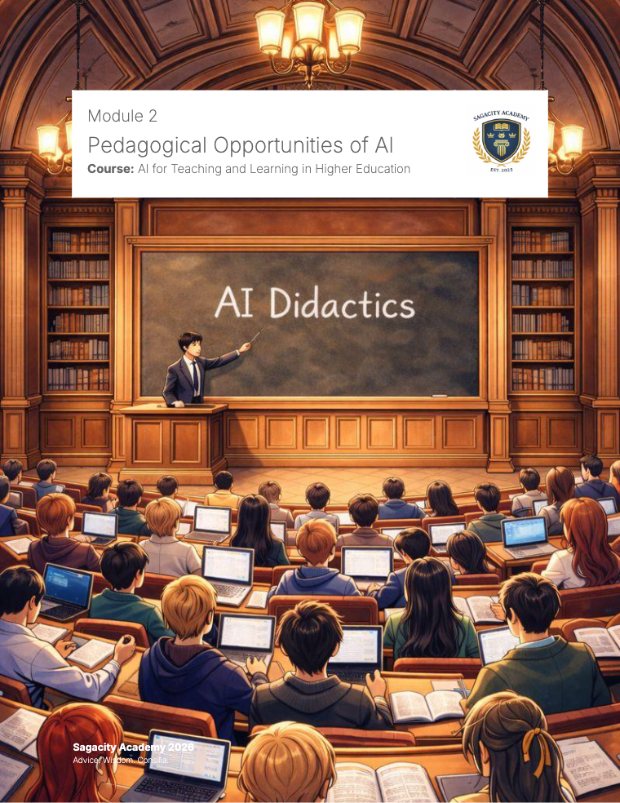
Cover of Module 2: Pedagogical Opportunities of AI
Module 2 · Pedagogical Opportunities of AI

How AI changes what students need to learn. Critical AI literacy, spotting and correcting a hallucination, and prompt engineering taught through weak-versus-strong worked examples.

  • Shifts in the skills students need
  • Detecting and correcting hallucinations
  • Prompt engineering fundamentals
Cover of Module 3: Using AI in Classes and Courses
Module 3 · Using AI in Classes and Courses

AI as a co-teacher: generating examples, explanations and simulations, and assisting with formative feedback — walked through step by step, including where the instructor must intervene.

  • Examples, explanations, simulations
  • Formative feedback support
  • A five-step classroom sequence
Cover of Module 4: Designing AI-Integrated Learning Activities
Module 4 · Designing AI-Integrated Learning Activities

Four assignment templates you can lift straight into a course, each with an applied example from a different discipline — sociology, microeconomics, educational psychology, media.

  • AI-supported drafting and revision
  • AI-assisted problem exploration
  • Research starter and creative production
Cover of Module 5: Ethical, Legal and Equity Considerations
Module 5 · Ethical, Legal and Equity Considerations

Who owns AI-generated content, what happens when a citation is fabricated, how to cite an AI tool, and the FERPA and GDPR essentials that apply the moment student work meets a model.

  • Copyright and intellectual property
  • Citing AI tools correctly
  • FERPA and GDPR essentials
Cover of Module 6: Best Practices for Onboarding Students to AI
Module 6 · Best Practices for Onboarding Students to AI

How to set expectations students actually follow: a course-specific policy, concrete acceptable and unacceptable examples, and low-stakes practice that models responsible use.

  • A course-specific AI policy
  • Acceptable vs unacceptable uses
  • Evaluating output for accuracy and bias
Cover of Module 7: Building Your Own AI-Enhanced Course
Module 7 · Building Your Own AI-Enhanced Course

A design workshop, not a lecture. Five steps from course goals to aligned assessment, then you redesign one real module or assignment with guidance and peer review.

  • Five-step course design workshop
  • Redesign one module with guidance
  • Peer review and sharing
Cover of Module 8: Implementation, Evaluation and Improvement
Module 8 · Implementation, Evaluation and Improvement

Running it for real: gathering feedback that tells you something, measuring learning impact rather than satisfaction, and improving the design before the next cohort.

  • Pulse checks, micro-surveys, focus groups
  • Measuring learning impact
  • Iterating for the next semester

Free of charge. Work through it at your own pace, or run it as staff development for a whole department.

Request access
Course content

Curriculum built for the age of AI.

Beyond the free courses, we co-create AI-native course content with educators and subject-matter experts.

ChatTutor / {{ t.navContent }}
Co-creation

Curriculum that is built for the age of AI.

Partner with us to design curriculum where AI is not an add-on, but an integrated part of pedagogy, assessment and student engagement.

New content, from scratch

We work with educators and subject-matter experts to design AI-native learning experiences in your field — the learning goals, the activities and the assessment logic together, not bolted on afterwards.

Upgrading what you already teach

Existing material becomes an AI-native course: the same syllabus, restructured so the agent has something to be grounded in and the assessment still measures reasoning.

Alignment, ethics, method

Our team supports you in aligning learning goals, ethical use and innovative teaching methods — including what happens to assessment when the answer is always available.

How a collaboration runs

Three conversations, then a course.

01Scoping

We look at the course as it exists: material, cohort size, assessment, and what is currently failing to scale.

02Co-design

Together we rewrite the learning path — where AI participates, where it stays out, and how reasoning gets assessed.

03Build and iterate

We configure the agents, run the course, and refine it against what the analytics show after the first semester.

Start shaping the next generation of curriculum.

Tell us the course and the field of expertise you want to build in, and we will come back with a concrete proposal.

ChatTutor / {{ t.navPrivacy }}
Privacy policy

How we handle your data.

Of ChatTutor.io. We are committed to protecting your personal data and respecting your privacy. This policy explains how we collect, use, disclose and safeguard your information when you use ChatTutor.

GDPRFERPADPO: Kurt Nielsen
1

Introduction

We are committed to protecting your personal data and respecting your privacy. This Data Privacy Policy explains how we collect, use, disclose and safeguard your information when you visit our application ChatTutor.

2

Information we collect

We may collect and process the following types of personal data:

  • Personal identification information — name and email address.
  • Technical data — IP address, browser type, operating system.
  • Usage data — information generated when you use the application: chat, interaction with learning material, uploaded files.
3

How we use your information

  • To provide, operate and maintain our services.
  • To improve, personalise and expand our services.
  • To communicate with you, including customer service and support.
  • To process transactions and send related information.
  • To comply with legal obligations.
4

Sharing your information

We do not sell, trade or otherwise transfer your personal data to outside parties except as described in this policy. We may share your information with third-party service providers (including the LLM used), and where required by law or to protect our rights.

5

Data security

We implement a variety of security measures to maintain the safety of your personal data. We monitor security issues for the packages we use, including through open-source intelligence tools.

6

Your data protection rights

Note that we use external service providers to generate the output or track performance of our platform — for instance, we allow users to use OpenAI’s ChatGPT to generate chat output, as outlined in section 9. By using our service you agree that we may send data to third-party providers, and this data is subject to their terms of service.

Depending on your location, you may have the following rights regarding personal data stored on our services:

  • Access — request copies of your personal data.
  • Rectification — request correction of information you believe is inaccurate.
  • Erasure — request that we erase your personal data, under certain conditions.
  • Restrict processing — request that we restrict processing, under certain conditions.
  • Object to processing — object to our processing of your personal data, under certain conditions.
  • Data portability — request transfer of collected data to another organisation or directly to you, under certain conditions.
7

Technical setup

The software is a website (chattutor.dk) which allows students to see their course material as PDF files and get help from an AI agent (a large language model such as ChatGPT). These features are enabled by parsing the PDF files of the course material.

  • The front-end application uses JavaScript and HTML, executed by the user’s browser.
  • The back-end application uses Python and handles all user requests — storing and retrieving data, calling external services.
  • A server runs the back-end.

ChatTutor is written in Python using the Django framework, assessed against CIS Benchmarks. We follow standard recommendations, select packages with widespread commercial use, and avoid trial versions and libraries with controversial licensing or source availability.

8

Infrastructure

ChatTutor is currently hosted on DigitalOcean. The server is physically located in Frankfurt, Germany. The server instance follows a typical Django configuration built on open-source products in widespread commercial use. The four main services are:

  • NGINX — gateway and hosting of static files.
  • Gunicorn — main application server.
  • Daphne — websocket server.
  • PostgreSQL — database server.
9

External services

We use the following types of external services which may process user-sensitive data: LLM endpoints for generating answers, PDF OCR services for parsing equations (all PDF documents are stored and served from our own servers), hosting services for sending and receiving email, and bug aggregation and performance monitoring tools. This website also uses HubSpot to run the trial sign-up form and the meeting scheduler; when you open either, HubSpot receives the details you enter and sets its own cookies in your browser to relate your submission to your visit.

ChatTutor is designed to store data centrally on a server we control, and uses third-party dependencies only as demanded. Third-party services in all cases process data stored on our servers; they are never the primary storage medium for user-sensitive data.

  • AI on-Demand — terms and conditions.
  • OpenAI paid LLM endpoint — terms of use; accessed through OpenAI’s own library (Apache-2).
  • Mathpix Convert OCR — terms of use; accessed over HTTP, so no library licence applies.
  • One.com — domain name hosting and SMTP service (terms).
  • HubSpot — forms and meeting scheduling on this website, used to handle trial sign-ups and booking requests (privacy policy). Data submitted through these forms is processed in HubSpot’s EU region.
10

Third-party dependencies

Our system uses the tools, libraries, modules and databases listed at gitlab.compute.dtu.dk/chattutor.

11

Changes to this policy

We may update this Data Privacy Policy from time to time. We will notify you of any changes by email. You are advised to review this policy periodically.

12

Contact us

If you have any questions about this Data Privacy Policy, please contact our Data Protection Officer (DPO): Kurt Nielsen at kurt@chattutor.io.

ChatTutor · Richard Petersens Plads 21, 2800 Kgs. Lyngby, Denmark · CVR 45092089

Blog post

The Pedagogical Framing of AI in Higher Education


Connect on LinkedIn
A teaching team gathered around a table with laptops open

The same AI tool can support very different kinds of learning

The same AI platform can lead to very different learning experiences. The difference often lies not in the technology itself, but in how educators choose to integrate it into teaching.

In our previous post, we asked what kind of learning AI should support. This raises a natural follow-up question: if we know what we want students to learn, how do we design AI to support it?

One answer lies in something that often receives less attention than the technology itself: the pedagogical framing.

The technology is rarely the deciding factor

Imagine two educators using exactly the same AI platform. The first introduces it as a place where students can ask questions whenever they get stuck.

The second creates several AI agents with different response styles, each encouraging students to approach the material differently. One agent challenges assumptions, another encourages reflection, while a third gives more direct guidance when students are stuck. We describe this approach in more detail in Use case 1, Engaging students through different response styles.

The technology is identical. The learning experience is not. The difference lies in how the technology is framed.

Those choices are not neutral. They shape how students engage with tasks, what kind of effort is expected, and ultimately what students learn from the experience. This is closely connected to the ideas we explored in Two Schools of Learning in the Age of AI.

Generative AI can be used to check answers quickly or to explore how ideas connect. It can help students complete tasks efficiently, or encourage them to think more carefully about them. That is what we mean by pedagogical framing.

Researchers do not always agree on how AI should be used in education. But one idea appears again and again: technology alone does not determine learning. How it is integrated into teaching matters just as much. Different pedagogical framings can lead students to engage with the same AI tool in fundamentally different ways.

Pedagogical framing is about purpose

Pedagogical framing begins before students ask their first question. It starts with the educator asking:

  • What do I want students to learn?
  • How should AI contribute to that learning?
  • What should remain the students’ own responsibility?

These decisions shape how AI becomes part of the course. The technology is no longer just available. It has a pedagogical role. The educational value of AI depends as much on course design as on the technology itself.

Another example is an educator who designed an AI-supported role-play around pharmaceutical regulation. Instead of positioning AI as a source of answers, students interacted with it as part of a realistic professional scenario where the AI agent performed as the company seeking approval of a medical product, and students were assigned different roles, such as regulator, bioethics expert, or reimbursement specialist.

The technology remained the same, but its educational purpose changed. We describe this approach in more detail in Use case 3, role-based investigation in a pharmaceutical approval scenario.

From “What can AI do?” to “What should AI support?”

Much of the current discussion about AI asks what the technology can do. Can it summarise articles? Can it explain difficult concepts? Can it generate quiz questions?

These are useful questions, but for teachers, another question may be even more important: what should AI strengthen in this particular learning situation?

The answer will not be the same in every learning situation. Sometimes the goal is to help students connect ideas across different topics. Sometimes it is to encourage reflection. Sometimes it is to make misconceptions visible. The same technology can support all of these, but only if it is framed accordingly.

Technology does not create pedagogy

Introducing AI changes the learning environment. Whether it supports learning depends on how it is designed into teaching. That includes:

  • how students are introduced to AI
  • what kinds of questions AI encourages
  • what learning goals it supports
  • what remains the student’s own responsibility

In other words, pedagogy shapes technology — not the other way around.

Designing AI as part of teaching

This is how we approach the design of ChatTutor: not by asking how AI can do more, but by asking how it can better support different ways of teaching and learning.

That is why ChatTutor is designed to let educators shape how AI participates in learning, rather than simply giving students access to a chatbot. Instead of asking instructors to adapt their teaching to AI, ChatTutor is designed so AI can be adapted to different teaching goals.

That means thinking about learning objectives before prompts. Teaching activities before features. And pedagogy before technology.

If you are interested in seeing how different ways of framing AI look in real teaching contexts, explore our use cases.

Closing

Ultimately, the educational value of AI depends less on the technology itself than on the learning experiences we intentionally design around it. The same AI tool can support very different kinds of learning. The difference lies in the pedagogical choices surrounding it.

The real opportunity is to design learning environments where AI helps students think more deeply, reflect more critically, and learn more intentionally.


Suggested reading

This post draws on established perspectives in learning theory and didactics, including traditions that emphasise learning as a situated, reflective process (e.g. Dewey), distinctions between different approaches to learning (e.g. Marton), and research that connects design, practice, and iterative development in real educational settings (e.g. Brown; Design-Based Research Collective).

Constructive AlignmentJohn Biggs (1996)
Design-Based ResearchAnn Brown (1992) · Allan Collins (1992) · DBR Collective (2003)
Experience and EducationJohn Dewey (1938)
Approaches to LearningFerence Marton & Roger Säljö (1976)
Constructive Alignment in Higher EducationFrancesca Morselli (2024)
Critiques of Constructive AlignmentDavid Newby (2025)
Blog post

Two Schools of Learning in the Age of AI


Connect on LinkedIn
Students gathered around a laptop, working through material together

Why generative AI forces us to clarify what we mean by learning

Generative AI has changed many things in education. But perhaps its most important effect is this: it forces us to clarify what we mean by learning.

For decades, learning research has distinguished between performance and understanding. Between getting the answer and building the mental model behind it. Between visible progress and durable insight.

Research traditions within educational psychology and learning science have long explored questions of durable learning, productive struggle, transfer, metacognition, and sensemaking.

AI did not invent this tension. It amplifies it. And suddenly, AI design is no longer just technical. It is philosophical.

School One: Learning as visible performance

In the first school, learning is demonstrated through correctness, speed, and measurable progress. You answer correctly. You answer faster. You make fewer mistakes. Improvement is visible. It can be tracked. It can be documented.

There is something reassuring about this model. Students know where they stand. Teachers can point to development. Feedback is clear and immediate.

Generative AI fits comfortably within this model, as it is fluent, responsive, and remarkably efficient. Ask a question, receive a polished answer. Try again, improve the phrasing. Iterate quickly.

In many contexts, that emphasis is justified. Precision, efficiency, and performance matter. This school is not about cutting corners. It is about clarity and optimisation.

But the key question is what kind of learning is being strengthened?

School Two: Learning as understanding

In the second school, learning is not primarily about producing the right answer. It is about building a robust and transferable mental model.

Here, the question shifts. Not “Can I solve this task?” But “Do I understand why this works?”

Understanding is slower to reveal itself and does not always come with a visible score. It often includes hesitation, revision, and moments of productive confusion.

Research in cognitive and educational psychology consistently shows that learning that feels effortful in the short term often leads to stronger retention and better transfer over time. In other words, effort matters.

When students must explain, compare, justify, and reflect, they are not only completing a task; they are reorganising their understanding. This kind of learning is often less visible and less immediately measurable. It can even feel inefficient. But it is more robust.

For AI to support this approach, it cannot only deliver answers. It must ask questions back. It must encourage reflection. It must leave space for uncertainty rather than rushing to fill it.

In other words, it must resist the temptation to be too helpful.

Speed is not understanding

Generative AI rarely hesitates. It rarely says, “I am not sure.” It rarely pauses and invites you to think first. It is designed to respond.

That design strength tends to support learning environments focused on performance and rapid feedback. But the same technology can also be shaped differently.

  • AI can prompt explanation rather than replace it.
  • It can scaffold reasoning rather than shortcut it.
  • It can make thinking visible rather than invisible.

The difference lies not in the AI alone, but in the pedagogical assumptions embedded in the interface.

Design is a choice

AI tools are not neutral. They embody decisions about what to reward, what to simplify, and what to foreground.

Do we reward speed? Do we reward reflection? Do we reduce friction everywhere? Or do we preserve some of it?

Choosing an AI tool is therefore also choosing a learning philosophy, whether explicitly or not.

Both schools of learning exist in real educational contexts. Most classrooms contain elements of both. The important step is not to declare a winner. It is to recognise the distinction and design deliberately.

Where ChatTutor stands

At ChatTutor, we design with learning as understanding in mind. Students still need to produce, articulate, and refine their work. Performance matters. But the system is built to support dialogue, conceptual clarity, and metacognitive awareness rather than simply accelerating completion.

More importantly, our aim is not to prescribe a single way of using AI in education. It is to give educators a language for these distinctions and the flexibility to adapt AI to their own pedagogical context.

Generative AI can strengthen different aspects of learning. Making those choices visible is part of responsible AI literacy. Designing for understanding does not oppose performance. It situates performance within a broader learning process.

Generative AI forces institutions to clarify what they value. The question is no longer whether to use AI in education. It is what kind of learning we want AI to support.

Suggested reading
Achievement goal theoryCarol Ames
Deep and surface approaches to learningMarton, F., & Säljö, R.
Desirable difficulties to enhance learningBjork, R. A.
Learning as sensemakingBruner, J.
Transfer of learningPerkins, D., & Salomon, G.
Constructive alignmentBiggs, J.
MetacognitionFlavell, J.
Sociocultural learning theoryVygotsky, L.
ChatTutor / {{ t.navCases }}
{{ t.ucE }}

{{ t.ucH }} {{ t.ucHem }}

{{ t.ucLede }}

{{ t.wfE }}

{{ t.wfH }} {{ t.wfHem }}

{{ t.m1t }}

{{ t.m1l }}

  • {{ t.m1a }} {{ t.m1ab }}
  • {{ t.m1b }} {{ t.m1bb }}
  • {{ t.m1c }} {{ t.m1cb }}
{{ t.m2t }}

{{ t.m2l }}

  • {{ t.m2a }} {{ t.m2ab }}
  • {{ t.m2b }} {{ t.m2bb }}
  • {{ t.m2c }} {{ t.inDev }} {{ t.m2cb }}
{{ t.m3t }}

{{ t.m3l }}

  • {{ t.m3a }} {{ t.m3ab }}
  • {{ t.m3b }} {{ t.m3bb }}
  • {{ t.m3c }} {{ t.m3cb }}
{{ t.m4t }}

{{ t.m4l }}

  • {{ t.m4a }} {{ t.m4ab }}
  • {{ t.m4b }} {{ t.m4bb }}
  • {{ t.m4c }} {{ t.m4cb }}
{{ t.m5t }}

{{ t.m5l }}

  • {{ t.m5a }} {{ t.m5ab }}
  • {{ t.m5b }} {{ t.m5bb }}
  • {{ t.m5c }} {{ t.m5cb }}
{{ t.m6t }}
{{ t.coming }}

{{ t.m6l }}

  • {{ t.m6a }} {{ t.m6ab }}
  • {{ t.m6b }} {{ t.m6bb }}
  • {{ t.m6c }} {{ t.m6cb }}
01
{{ t.r1t }}
{{ t.r1m }}

{{ t.r1b }}

02
{{ t.r2t }}
{{ t.r2m }}

{{ t.r2b }}

03
{{ t.r3t }}
{{ t.r3m }}

{{ t.r3b }}

04
{{ t.r4t }}
{{ t.r4m }}

{{ t.r4b }}

{{ t.ucCta }} {{ t.ucCtaEm }}

ChatTutor / {{ t.navCompliance }}
{{ t.cpE }}

{{ t.cpH }} {{ t.cpHem }}

{{ t.cpLede }}

{{ t.regE }}
{{ t.aiT }}

{{ t.aiB }}

{{ t.dpE }}
{{ t.gdT }}

{{ t.gdB }}

{{ t.srE }}
{{ t.feT }}

{{ t.feB }}

{{ t.acE }}
{{ t.wcT }}

{{ t.wcB }}

{{ t.cqE }}

{{ t.cqH }} {{ t.cqHem }}

{{ t.cq1 }}

{{ t.ca1 }}

{{ t.cq2 }}

{{ t.ca2 }}

{{ t.cq3 }}

{{ t.ca3 }}

{{ t.cq4 }}

{{ t.ca4 }}

{{ t.cq5 }}

{{ t.ca5 }}

ChatTutor / {{ t.navAbout }}
{{ t.abE }}

{{ t.abH }} {{ t.abHem }}

{{ t.abLede1 }} Human Thinking{{ t.abLede2 }}

{{ t.teamE }}
Marius Cortsen
Marius Cortsen
{{ t.roleCEO }}
Tue Herlau
Tue Herlau
{{ t.roleCTO }}
Sebastian Thielke
Sebastian Thielke
{{ t.roleHoP }}
Lars Kai Hansen
Lars Kai Hansen
{{ t.roleAdv }}
Kurt Nielsen
Kurt Nielsen
{{ t.roleCPO }}
Mikkel Marfelt
Mikkel Marfelt
{{ t.roleCSO }}
{{ t.footContact }}

{{ t.ctH }} {{ t.ctHem }}

{{ t.ctP }}

{{ t.officeE }}
Richard Petersens Plads 21
2800 Kgs. Lyngby
Denmark
{{ t.partOfE }}
Human Thinking, Kgs. Lyngby
ChatTutor / {{ t.navPressLong }}
Press, media & blog

Coverage, research and thinking out loud.

Media coverage and research reports speak louder than words. Below: where ChatTutor has been written about, and where we work through what generative AI actually does to teaching.

Blog

Slowing down to think it through.

Generative AI is changing what it means to teach and to learn — often faster than anyone has time to make sense of. Expect reflections on pedagogy, learning science, and the everyday choices that decide whether AI strengthens learning or quietly replaces it.

{{ t.tBadge }}

{{ t.tTitle }}

{{ t.tLede }}

{{ t.fNote1 }} {{ t.fNote2 }} {{ t.privacyLink }}.

{{ submitError }}

{{ t.fNote1 }} {{ t.fNote2 }} {{ t.privacyLink }}.

{{ t.tSentBadge }}

{{ t.tSentTitle }}

{{ t.tSent1 }} {{ sentEmail }} {{ t.tSent2 }} hello@chattutor.io.

{{ t.cBadge }}

{{ t.cTitle }}

{{ t.cLede }}

Marius Cortsen
{{ t.cRoleLine }} marius@chattutor.io

{{ t.cNote }}

{{ t.cSentBadge }}

{{ t.cSentTitle }}

{{ t.cSent1 }} {{ sentEmail }} {{ t.cSent2 }} marius@chattutor.io.

{{ openCase.n }}

{{ openCase.title }}

{{ t.englishOnly }}

{{ para }}

{{ openCase.who }}
{{ openCase.role }}